Thursday, August 1, 2013

Quietly Meditating.....

below the bell n the beads


Stillness and tranquillity.....

The bronze bell dates to the  Ming emperor Wan Li (1572-1582) The strand consists of rock crystal and coral beads from Myanmar, Indonesia and China. The little jade scholar of unknown age and period comes from China and measures 7.5cm x 4 cm.
 
 
What enigmatic thoughts!


A close up of the strand of beads


The antique melon shaped crystal bead is from China.


Wednesday, July 3, 2013

I love collecting ......


.......Elephant beads.....


Elephants are an important cultural icon in Asia. For centuries they have been used as beasts of burden because of their great strength, memory, intelligence  and trainability. In the past, elephants have also served in royal battles between Thailand and Burma with kings mounted on them as seen in many paintings. It is no wonder they are so loved  and have been depicted in many carvings and works of art. Although the elephant is such a large animal, in Asia they are often made into  small objects such as beads and seals.

My elephant beads/seals are from Myanmar, Cambodia, Thailand and China and they may date from ancient to vintage.

First I'll show the greens from Myanmar's Pyu dynasty (from 2nd century BC to 11th century AD)


greenstone elephant beads  from Pyu period


Here are the  white ones also from Pyu dynasty


quartz  and bone Pyu period


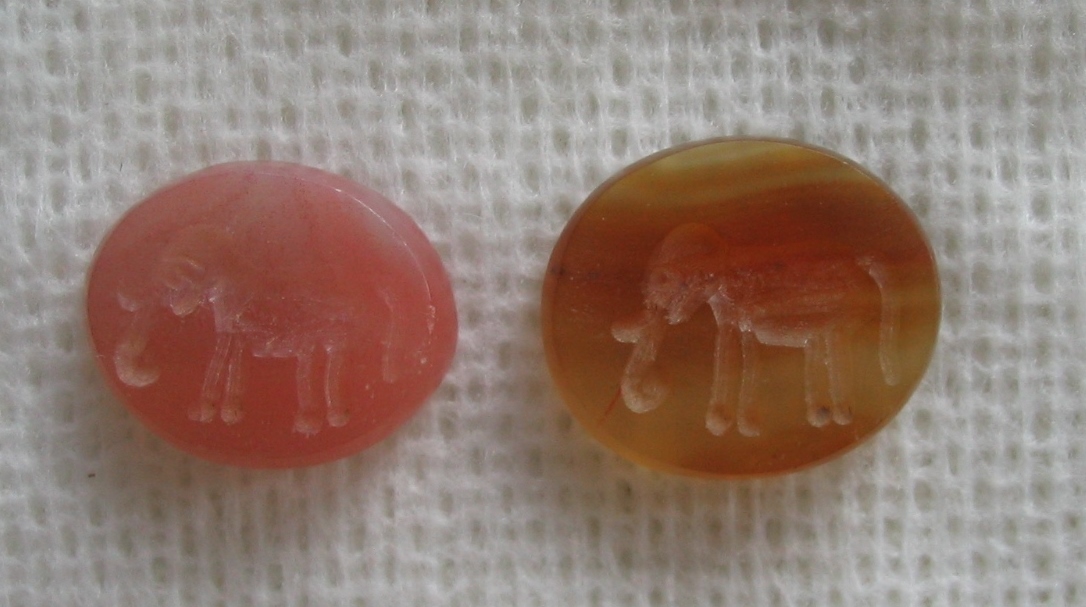
These 2 seals are from Cambodia and have intaglio carving of elephants.


elephant seals from Cambodia

 
While these seals may date to the Khmer period,( around 9th-13th centuries) present day Cambodian elephants take tourists for rides in Seam Reap as seen below.


Ride a friendly elephant
 
 And tourists riding on elephants are replicated in these modern  jade pendants from Myanmar.
 
 
Elephant rides depicted in modern  jade carving

 
The carved jade elephant below hails from China. It is perforated from top to bottom and so it is also a bead. Carved in the round with patches of brown, the body undecorated but showing ears,  tucked trunk, tail and eyes it measures 4x2cm       and is quite an engaging figure.


Jade elephant from China
 
 Most Chinese jade elephant carvings seen on the antiques market today are around the Qing dynasty. Ancient elephant carvings from China are not  common though elephants did roam the Central Plains judging from the many elephant tusks recovered from the  Jinsha and Sanxingdui  (around the 12-11th centuries BC) excavations in Sichuan Province, China. 


Showing ivory tusks from the Jinsha Onsite Museum


There is also a jade elephant excavated from Fu Hao's tomb, Shang dynasty(around 1766-1027BC)  But I doubt that my plumb little elephant is of that great age.  Except for the 2 horizontal carving lines on the belly there are  no decorative patterns that can relate it to an ancient  period. And yet it does not look like a modern copy -   so, another mystery....

 Here is a 1960s elephant made of bone or ivory from Thailand
 
 
vintage elephant from Thailand
 
And here is the whole vintage strand
 
 
Vintage strand of elephant, lotus and beads
 
Below is another strand composed of  greenstone beads, carnelian buttons and one small elephant.
 
 
Beads and pendants from Pyu dynasty
 
And finally, my favourite elephant and other greenstone bracelet. The centre bead is serpentine from China.
 
 
Composed of 2 elephants and other greenstone beads


Close up of the flat nephrite elephant bead which measures.10mm.
 
 
Greenstone  elephant bead from Pyu. 15mm long


Wednesday, May 1, 2013

An Ornament from the Past

 
         the le le


These little odd shaped beads ( should I call them beads because they have perforations ?) had me wondering for sometime about their origin and use. I had bought them from a seller who could only say "le le" by way of description and as I am not fluent in Chinese,  I was none the wiser. I did try the bi-lingual dictionaries but got not much help. For all I know he may be having me on !

6 funnel-shaped jade objects called Le le

The six dark color nephrite stones narrow from the middle with the bottom wider than the top, may be described as trumpet-shaped or funnel-shaped. Measuring around 2 cm, each piece is drilled from top to bottom and  the holes are small.  None of the pieces are  of the same height or size and each "le le" is partially covered with patina of age. The le les  are entirely plain with no surface decorations or carvings.

Here is a picture showing the bottom ends and looked at from this angle their shapes are reminiscent of the supertrees in our Garden by the Bay Park or even ancient toadstools from a jurassic park :)


bottoms up they look like ancient toadstools or supertrees!

Supertrees, Garden by the Bay Park

To learn more about their source and origin I searched through many publications on early jade and found some useful references and illustrations. In Roger Chow's book Sparkling Splendours there are similar funnel shaped objects in crystal and agate form. He has described them as ear ornaments and attributed them to Han dynasty(206 BC – 220 AD) On the other hand, in Jessica Rawson's Chinese Jade from the Neolithic to the Qing similar shaped  jade beads  were dated to Dong Zhou-Han dynasty (5th-2nd century BC)

However Rawson's examples are more than thrice the size and have elaborate carvings and large holes.   Size and decoration wise my le les (small size, plain and small holes) are more in keeping with the crystal and agate samples shown in Sparkling Splendors by Roger Chow. So I am more inclined to  to think they are ear ornaments dating from that period (Han)

As ear ornaments I guess they could have been set with gold and pearls, or strung with silk threads and the hole facilitates  attachment to the ear. Perhaps they were worn as dangle earrings  like the one I tried to recreate below ?


le le as earring
 
le can also be used as a pei or accessory to be strung up with other beads/ornaments  to form a pectoral (chatelaine).I don't have enough ancient components to form a dramatic pectoral such as those shown in books. But here is my shot at making a mini pectoral, consisting of funnel shaped les, xizhou carnelian discs, one silkworm and one very old pearl bead.

 
mini pectoral
 
They also look nice strung with white calcite discs as a contrast.


strimg with carnelian and white calcite discs


Although  my les have no provenance I'll let the pieces speak for themselves :)

*Postscript:
Just got hold of the book Lazurite : a journey into ancient China. According to the book ear ornaments called er dang were fashionable with ladies of the Han era. These er dang were made in glass and were funnel shaped. The book shows many examples of these er dang or ear ornaments which have been attributed to Warring States and Han dynasty excavations.


Wednesday, April 10, 2013

SIMPLY DAZZLING ......


...to hold and behold


Here is a treasured necklace, composed of 16 old rock crystal beads and one quartz elephant bead. The crystal  beads remind me of ice while the quaint elephant has a touch of the evergreen.


Crystal on the rocks
 
These faceted rock crystals have weathered well through the centuries, retaining a genteel sparkle. The perforations drilled from both sides can be clearly seen through the translucent crystal.

translucent and brilliant


crystals close up

The centrepiece of the necklace is a quartz elephant from Myanmar's Pyu Dynasty 167-1044 AD.  It is zoomorphic in appearance and such elephants can be found in Pyu's repertoire of stone carvings. This one has been damaged and repaired. A close up of the elephant showing its repaired head and parts of the body can be seen below


Quartz elephant from Pyu dynasty


The crystal beads were sold as Yuan dynasty (1279-1368) by a China dealer but its hard to determine the exact vintage. Meanwhile it's still a lovely strand to hold and behold.


...to hold and behold...
 

Saturday, February 9, 2013

LUNAR NEW YEAR OF THE SNAKE 2013


To greet Chun jie 2013 I composed this little jade snake picture from my cache of flat jade plaques. The head has a carving of a heron while the body is made up of the auspicious characters Fu meaning blessings. The tail is of a fruit with leaves.


Madam White Snake and Her aide Little Green Snake is also here to welcomes Lunar New Year of the Snake !


A pair of charmers


There are not many  snake objects in my collection but I did manage to turn up this charming pair. White snake on the left measures 3.5cm by 2 cm while the little curled up bundle on right measures 2cm by 0.9cm.

As the reverse of both jades have the prosperity symbol of a coin, they must have been made for lunar new year purpose.


green snake has the prosperity symbol of a carved coin on the back of its head.

prosperity coin symbol scratched on the reverse of white snake


Butterflies and flowers are also emblems of good luck for the new year as shown in my next jade picture.


Its New Year's Eve 2013, and life is great again ! May the  charming         2 0 1 3   S n a k e    slither in with blessings of health and happiness and most importantly, bring me Yu x2 ! Yu  as in abundance and Yu as in jade :)

Monday, November 5, 2012

ART IMITATES NATURE


Here are 2  tiny jade sculptures measuring about 1.5cm and 1.8cm each.   They look like fruits but what fruit is represented by their odd shape ?


Exotic jade fruit carving

According to a jade enthusiast friend, they are called "Buddha hands" after the exotic fruit  Citrus medica var sarcodactylis  or fingered citron.
 
To settle my curoisity I googled Buddha Hands fruit and found that such fruit hands are described as ...

  "  In China the Buddha’s Hand citron symbolizes happiness and long life, because its name, “fo-shou”, has those meanings when written with other characters. Chinese like to carry the fruit in their hands, place it on tables in their homes, and present it as a sacrificial offering at temple altars......
the Buddha’s Hand fruit was important by the 10th century A.D. in Fujian. Chinese artists classically depicted the fruit in jade and ivory carvings, in prints, and on lacquered wood panels "

With my interest piqued I tracked down this interesting fruit at our local market. Here is a picture of  one variety of the fruit.


Buddha Hands fruits, the Indonesian variety


large fruits and mini imitations in jade

 
Art imitates nature, so cute:)
 
These  hands with the fingers closed are somewhat different from those described in my earlier post  Beautiful Hands . But both are known as Buddha hands.
 
 I guess Hands is a much explored object in art.


Tuesday, September 25, 2012

BEADS OR PEBBLES ?


Are these are beads or pebbles.? Their unformed shape resembles little pebbles but they have holes drilled in them so they can be strung up as beads.  So are these Pebbly beads or beady pebbles?


Pebbly Beads or Beady Pebbles

These stones (agates) have a smooth texture with  a sprinkle of silvery  patina.


There is an hidden eye in this pebble/bead

Hidden Eye

If you look hard and deep with a loupe you can see the remains of wavy bands


Wavy Bands


Dropped Eye

The eye seemed to have dropped out from this piece revealing the quartzy interior.

Aren't  agates be they beads or pebbles just intriguing ?


Thursday, July 26, 2012

Queer Fish


This brown fish is, um a    bird !


looks like a fish

Picked up among the riff-raff of a flea market in China it is a tantalising piece of jade. My first impression was that it resembled a fish lying on its belly. I can even see fins and the scales.

But turn the fish upside down and hey presto it becomes a    bird !

looks like a bird

What looked like fins are now the feet. Just love these trick pieces :))

Is it ancient ?The stone is weathered and old. The piece looks handcarved. The obverse is almost completely corroded but traces of the original carving which is identical to the good side can still be seen.

Corroded side


Flat animal carvings like my fish/bird are often assigned to  the Shang-Zhou dynasty (1600-256BC) While this piece feels somewhat archaic, there is also something suspicious about the carving style. What is that eye-looking motif doing in the bird's wing ? The normal pattern should end with a 'C' scroll. Here it looks more like an eye from a Picasso painting ! What a mixmatch of styles, shapes, and periods. It could be some form of hybrid  art.

Wrong Eye!
Modern Art ?

Is this neolithic art, mordern art or forgers art. Well  interpretation may well be in the Eyes of the Beholder :))  Meanwhile this inexpensive piece has given me much thoughts to ponder.


Friday, May 4, 2012

Mercedes Benz Logo on Ancient Quartz Bead


The heading for this post sounds like some sensational web blast. But take a look at this bead and you will be struck by the resemblance to the famous logo.

Round crystal bead with  y-shaped perforations

This flat, round quartz/crystal bead with perforations arranged like a Y, looks like an imitation of  Benz logo, or is it the other way round ? Did archaic men have the same ideas as modern logo designers ? Hmmm, is it some time tunnel or thought transference thing that inspired  the look-alike :))  Measuring 2.5 cm the  translucency also shows off the perforations beautifully.

Purchased in China from one of the numerous road side stalls the ancient authenticity cannot be guaranteed. But here are some signs to consider. The bead is bevelled around the circular sides. Actually I am not sure whether bevelling is a sign of authenticity ! There are well defined ring tool marks in the perforations. Again it is hard to judge between ancient and modern tool marks.

Similar beads can be seen in Sparkling Splendours by Roger Chow p.125-126. and dating  them to Warring States period 475-221BC. I have also come across a similar specimen  on the net taken from China's Hubei museum which dates it also to Warring States.

However I was disappointed to learn that such beads have also been seen in the Panjiayuan Market scattered among other fakes. 

No doubt all the points for or against ancient authenticity that I have raised are subjective. But it is still a neat and intriguing bead and I have no regrets purchasing it. Now if only Benz would pay 3 mil for this ancient relic of their logo.  Ah, but dream on....:)

I tried hard to make a unique necklace out of this unique bead but could only come up with this pretty lame piece.

 unique or lame?  - make a vote

This crystal bead also comes with x-shaped perforations. Again examples of such beads can be seen in Roger Chow's Sparkling Splendours.

perforations form the letter x

I wonder whether there is any special purpose for these x and y shaped perforations. What was the original stringing like ? They could also have been used as cowries.

Mystery Beads


Blog Archive

Favourite Books

  • Theft : a love story
  • The Uncommon Reader
  • The Silent Patient
  • Never Let me go
  • Angela's Angels
  • Where angels fear to tread