......or have been
immortalized by Chinese cultures from Neolithic times to the 21st century. Chinese man have been intrigued by these strange creatures who emerge from the ground after years of hibernation to sing their haunting songs. I think it is this sequence of burial and birth that gives rise to the image of cicadas as a symbol of rebirth and immortality.
Cicadas feature in many forms of Chinese art including poetry, jade carvings, paintings and calligraphy. Here is a poem by Tang poetess Xue Tao celebrating the songs of cicadas :
Hearing Cicadas by Xue Tao
Washed clean by dew, cicada songs go far
and like windblown leaves piling up
each cicada's cry blends into the next.
Yet each lives on its own branch.
And here is an old picture taken of a mural from a Tang royal tomb depicting a scene of ladies watching birds catch cicadas.
 |
| Catching Cicadas Mural at Prince Zhang Huai tomb |
But it is cicadas celebrated in jade that I find the most enduring. Being a city dweller, I have never seen or heard the sounds of a real cicada yet I too have been beguiled into romancing and collecting the creature. I have quite a few jade cicadas in my collection which I will show. The first few cicadas I show are at the pupa stage rather than the full grown insect.
 |
| Possibly a Hongshan cicada pupa |
The first pupa is a Hongshan (around 3500-2500
BC)
hopeful. It has a thick, somewhat cylindrical body with flattish eyes at one end and a series of three wide, shallow grooves at the other. The remainder of the body is plain and tapers slightly towards the end. The large perforation near the head is funnel shaped, drilled from both sides with tool marks in it. It measures 3.5 cm. with rust seepage over the green jade surface. There are many examples in museums, reputable auctions and books of this pupa shape, form and color which have been attributed to Hongshan Culture.
|
| Probably Hongshan cicada pupa |
Here are 2 more pictures showing frontal view and flat base of this pupa.
 |
| front view |
 |
| flat base |
The next creature shown below is rather mysterious and raises many questions and doubts. It is made from jixue (chicken blood) stone. Although carved and shaped as an archaic piece there are some points that do not jell. The shape of the body, eyes, and grooves on its back resemble Hongshan style. However the 6 holes, 3 on each side of the body, presumably representing the 6 legs of a cicada and ending in a sort of base, is unusual for a Hongshan pupa. The chicken blood stone is also seldom seen on Hongshan artifacts. Could this be a later copy ?
 |
| Is this a cicada pupa made from attractive chicken blood stone? |
And unusual too, is the horizontal slit from the belly to the legs ending in the base, as shown below
|
|
| Tool marks can be seen in the slit |
To add another query, is the tiny quartz stone peeping out of the extreme right hole may have been left behind in the drilling process and which may be taken as a sign of antiquity or a sign of conmanship.
 |
| Quartz stone for drilling seen in hole on right |
So taking all the pros and cons into consideration, is this a very rare ancient early culture pupa or a modern day invention? Whatever the answer to me it is an enjoyable piece.
Next is this slightly arched and subtly sculpted cicada pupa. It measures 2.5cm and the most distinctive feature is the prominient eyes. The stone looks like chicken bone (ji gu) white jade showing reddish stains. The Chinese like to relate their jade stone with the chicken hence ji gu (chicken bone) and ji xue (chicken blood) What is it about jade that gets it mixed with chicken from chicken blood to chicken bone ? I hear there is also ji you (chicken oil) but unfortunately I don't have an example of such a stone to show.
 |
| Slightly arched with 2 prominient eyes |
It has an ox nosed perforation, the hole leads from top of head and exits through the face see picture below.
 |
| Ox nosed perforation |
The color of this incredibly smooth stone with its red stains is reminiscent of Liangzhu ( 3500– 2500 BC) artifacts
 |
| Liangzhu color beautiful piece |
By the time of the Han dynasty (206BC-220AD) cicadas were used as tongue amulets as well as ornaments. There is a Chinese saying which goes like this
In life use as pei (ornament)
In death use as han (tongue amulet)
The 3 cicadas shown below have wings and are no longer pupas. These cicadas are flat and stylised rather than lifelike. For the left and right cicadas the wings and heads section are indicated by 3 sharp cuts and the eyes and mouths by 3 slits. The centre piece has only one dividing centre line. Wonder whether this is the Han badao or 8 cut style. All the surfaces show patina and weathering.
 |
| Han yu |
A Chinese seller did tell me that cicadas carved in this "simple" fashion are likely to be recarved pieces. He's got a point there but there is something solemn and amuletish about them and perhaps they may be genuine tongue amulets from the Han dynasty.
Besides jade used as Han yu, glass was also sometimes used in the Han dynasty. The next cicada I show is a corroded specimen of a glass cicada.
 |
| glass cicada |
And the side view
 |
| side view |
The base is plain.
 |
| the base |
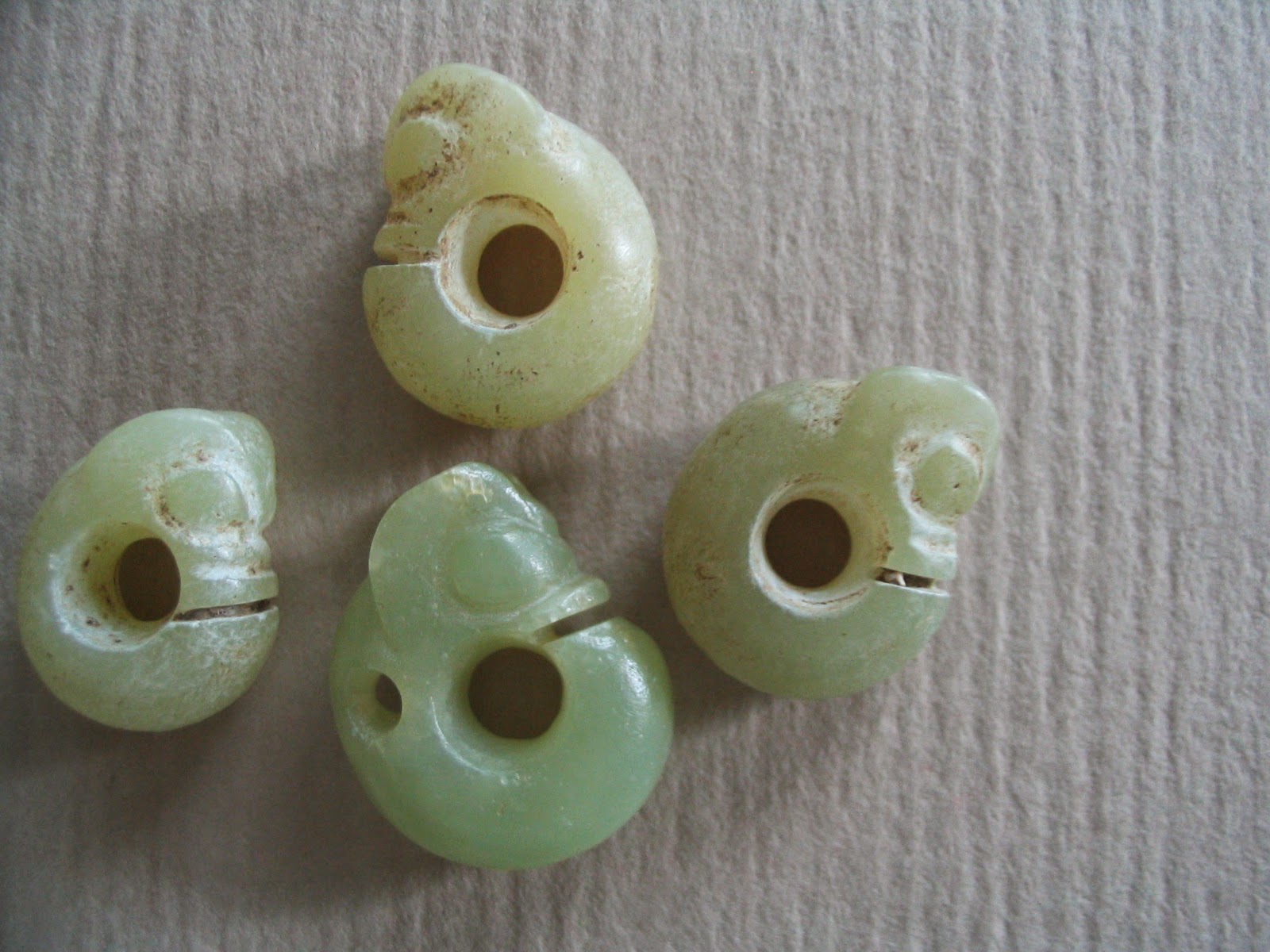
2 more small jade cicada beads shown below are beads pierced from head to tail end. These look like Shang - Xi-Zhou period (16thcentury-221BC) but hard to determine so I just enjoy them.
 |
| A pair of cicada beads |
Another full grown and life like cicada from late Qing (19th - early 20th century) is shown below. It measures 4.2 x 2.2cm. The wings and body are decorated with line carvings and it is pierced at the nose for attachment as pei or girdle ornament.
 |
| Late Qing green jade cicada |
To add variety, here are a couple of cicada snuff bottles from Heng's collection.
 |
Snuff bottles carved as cicadas
The obverse side |
Finally a very large crystal bead decorated with 3 cicada carvings on the surface. The age is indeterminate but it was the fashion from early dynasties to use cicadas as decoration on ornamental objects such as bis, plaques, congs, etc.
 |
| Large crystal bead with cicada decoration |
 |
| It measures 3.5cm x 7 cm and is decorated with three cicadas |
 |
| A side view showing 2 of the three cicadas |
Continuing the love for cicadas into the 21st century are these three modern day cicadas. They are pierced at the head and can be worn as pendants or used as toggles for handphones or handbags.
 |
| Recently carved cicadas in green and white jade |
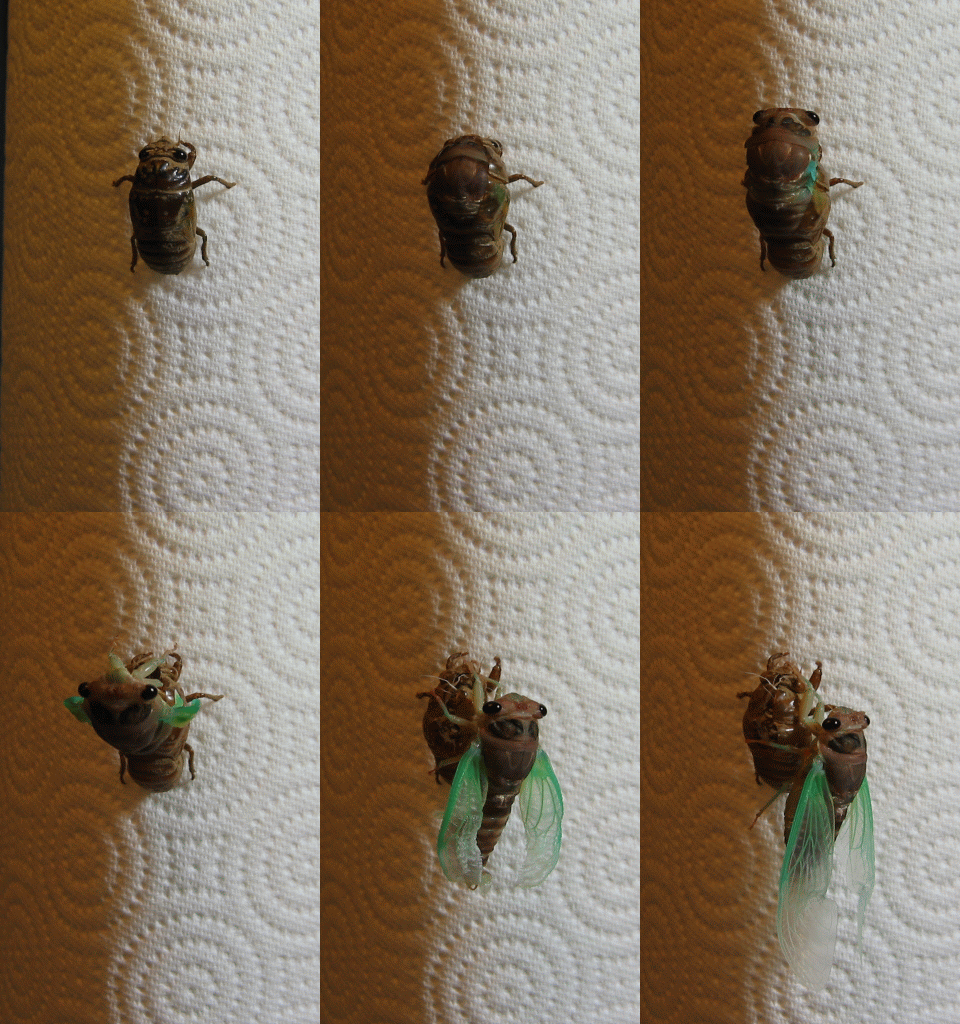
Cicadas Are Forever


.jpg)


+of+hong3.jpg)


