Showing posts with label shang dynasty. Show all posts

Saturday, March 4, 2017

A String of Beads and Pendants from early Chinese History


Inspired by the elaborate necklaces of the Xizhou dynasty,(1046-771 BC) I have come up with my own modest strand  using  beads and pendants  from early periods of China's civilization.

 
Mostly Shang - Zhou beads and pendants

Patina, toolmarks and carving style on these beads and pendants (silkworms, phoenix, turtle shell, disc etc) point tentatively to Shang - Xizhou period (1600-771 BC)  and later.

The strand is made up of  a trapezoidal jade bead, 2 silkworms, a spherical carved bead, a bead of turtle shell carving, two  bamboo shape tube beads and a pair of cicadas interspersed with small carnelian disc beads.

Details of the components given below.

Picture below shows beads with three different shapes. From left spherical bead with c-shaped  motifs (1.4cm), flat turtle shell bead (1.5 x 1cm) and a trapezoidal bead with phoenix carving (2 x 1.5cm at the base)


Bead shapes are spherical, flat and trapezoidal


Next is a pair of silkworm pendants the left worm is 3 cm and right is 2.8 cm.
 
 
Pair of silkworms

A pair of  slender bamboo shaped tubes with left tube measuring 2.0cm x 0.5cm and right 2.3cm x 0.5 cm

 
Left tube is 2cmx0.5cm right tube is 2.3cm x0.5cm

Pair of cicadas measures approximately 1.5cm x 1.2cm and likely to be later than Xizhou period.
 

Pair of cicadas


The carnelian disc beads used as spacers are the hallmarks of many Xizhou necklaces.
 

Small discs measures approx. 1 cm across


These red discs also add a touch of color to the otherwise somber hues of my string.

 
Rosy carnelian beads add a touch of color


Sunday, September 13, 2015

My 3 Birds

These 3 slim birds came from Myanmar. Two of the birds are of greenstone and one of light blue glass. All three are perforated from the top of the head to the tail and so are beads. Were they meant to be worn and what is their function ?


My three birds from Myanmar

 The larger of the greenstone birds is 6.5cm long. Of slender shape, its head is simply shaped with a pair of bulbous eyes, a beak and a peak at the back possibly representing a crest. The head is slightly uplifted.
 
Greenstone bird
 
The wings are carved more like a turtle shell and has three sharp slits on each side, while the perching claws are  tiny knobs.
 
3 slits at the wing side
 

The smaller bird is 5.2 cm long and is identical in design to the larger bird.
 

Smaller bird
 Here's a close up of the pair.
 
Close up

The blue glass bird is tiny measuring only 3cm. Its structural form follows that of the other two birds.
 
Blue glass bird

The tails of the 2 greenstone birds are leaf-shaped with a centre dividing line and are 3.2 cm and 2.2cm respectively. By comparison with the heads, the tails are in better condition and retain their lustre.
 
 
Long tails

 
 Bird forms of this type are also seen in Neolithic  China. There are examples of such birds in the publication Gu yu tu shi (Ancient Jade Patterns Explained) on page 067  attributed to China's New Stone age up to Shang dynasty (1600-1046 BC).
 
 During Myanmar's Pyu dynasty (around 2nd century BC to 11th century AD ), similar carnelian and agate bird forms  have also been found. Such birds have been described by collectors' as perching parrots and sometimes as parakeets. I am hoping that my birds belong to this category except the tails are much longer and I would perhaps call my birds  peacocks.
 
 
Peacocks or parakeets ?


Thursday, April 23, 2015

BABY ZHULONGS


Is this a Pig or a Dragon ? That is the question whether its a celestial dragon or a plebian pig....puzzles the  mind and makes us fly to wild theories ...:))

 
Pig or Dragon?

The experts says both hence Zhulong  as  Zhu=Pig and Long=Dragon. An unlikely marriage if you ask me. How a celestial mythical dragon became married to a plebian pig  baffles the brain but according to Wikipedia :
 
A pig dragon or zhūlóng (Chineset 豬龍, s 猪龙) is a type of jade artifact from Neolithic China. Pig dragons are zoomorphic forms with a pig-like head and elongated limbless body coiled around to the head and described as "suggestively fetal". Early pig dragons are thick and stubby, and later examples have more graceful, snakelike bodies.


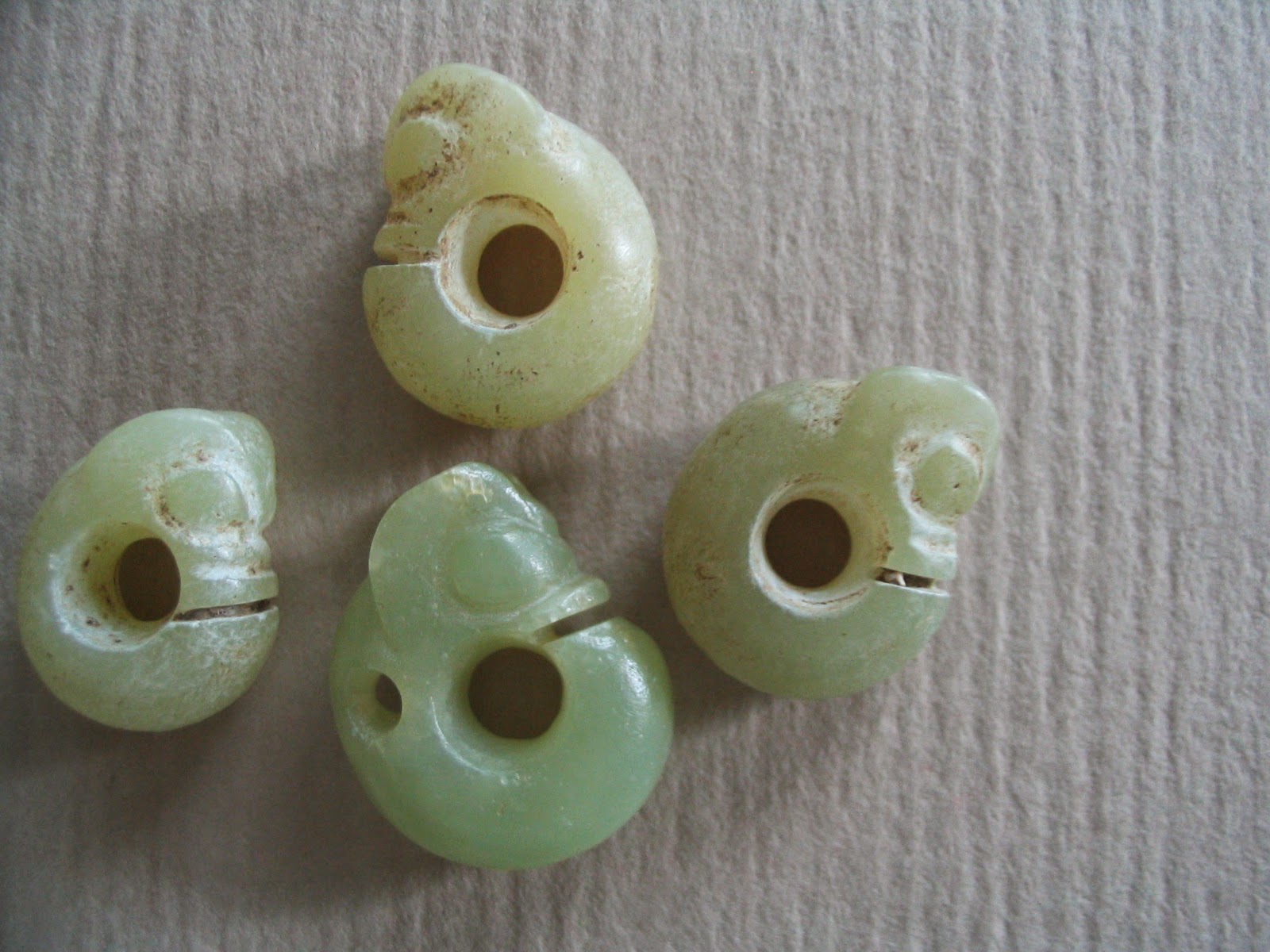
8 Zhulongs


Zhulongs are  hallmarks of the Neolithic Hongshan Culture (c. 4000–3000 bce) and are normally large imposing figures so I can't account for why my lot of 8 zhulongs  is so mini. Are they genuine artifacts or replicas is another unanswerable question. The only  examples of small size zhulongs that I have seen are documented in the book Language of Adornment by Filippo Salviati who showed 2 examples of mini zhulongs measuring 1.6cm x 2.2cm and another 3cm x 4 cm which are still larger than my pieces. 
 
 In the picture below my largest zhulong measures only 1.9 x1.6 cm   and  1.5 x1.3 cm for the smallest. All have uncut central perforations and of the 8 only 1 has a stringing hole. They also show the Hongshan characteristics of large heavy lidded  pop out eyes, curled up body, fly back ears and nose creases.


8 baby zhulongs
 
Four of the zhulongs are made from calcite
 
 
Calcite zhulongs

One of the calcite zhulongs is badly corroded on one side.
 
 
badly corroded on one side

 
Here are the rest of the zhulongs in nephrite jade.
 
 
Jade zhulongs


2 of the zhulongs are chewing on some ancient quartz. I know this quartz in a hole on ancient jade has been debunked by experts as  ploys to fake authenticity. But on these two it looks pretty natural
 
 
Zhulong chewing on quartz

 
 Although diminutive in size they still exhibit the essence of zhulongism especially that inimitable  expression of "the grimacing sneering look" as described by some writers. At the same time their smallness and coiled body makes them look less like some fearsome beast but more like a cuddly amulet ! (depends how you look at them) or even a panda.
 
 
Grimacing but cuddly !


According to some sources, zhulongs are recorded as being made "as late as the Shang dynasty..." around 1600-1050 BCE and I cherish hopes that mine may be Shang creations  which is still an immortal 3,000 (more or less) years ago.

 
immortal in terms of age!


Wednesday, July 3, 2013

I love collecting ......


.......Elephant beads.....


Elephants are an important cultural icon in Asia. For centuries they have been used as beasts of burden because of their great strength, memory, intelligence  and trainability. In the past, elephants have also served in royal battles between Thailand and Burma with kings mounted on them as seen in many paintings. It is no wonder they are so loved  and have been depicted in many carvings and works of art. Although the elephant is such a large animal, in Asia they are often made into  small objects such as beads and seals.

My elephant beads/seals are from Myanmar, Cambodia, Thailand and China and they may date from ancient to vintage.

First I'll show the greens from Myanmar's Pyu dynasty (from 2nd century BC to 11th century AD)


greenstone elephant beads  from Pyu period


Here are the  white ones also from Pyu dynasty


quartz  and bone Pyu period


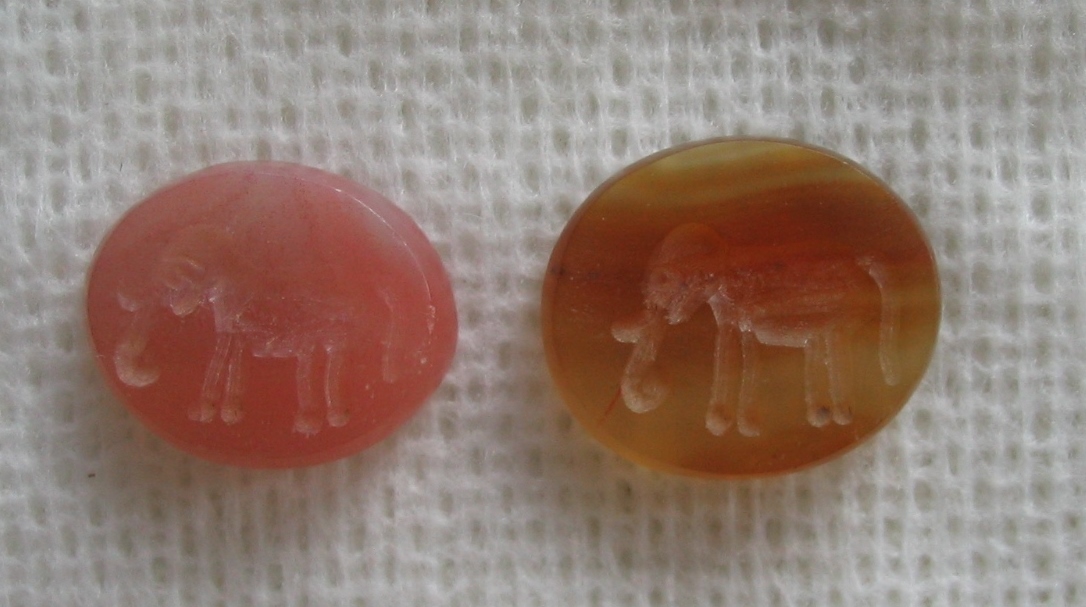
These 2 seals are from Cambodia and have intaglio carving of elephants.


elephant seals from Cambodia

 
While these seals may date to the Khmer period,( around 9th-13th centuries) present day Cambodian elephants take tourists for rides in Seam Reap as seen below.


Ride a friendly elephant
 
 And tourists riding on elephants are replicated in these modern  jade pendants from Myanmar.
 
 
Elephant rides depicted in modern  jade carving

 
The carved jade elephant below hails from China. It is perforated from top to bottom and so it is also a bead. Carved in the round with patches of brown, the body undecorated but showing ears,  tucked trunk, tail and eyes it measures 4x2cm       and is quite an engaging figure.


Jade elephant from China
 
 Most Chinese jade elephant carvings seen on the antiques market today are around the Qing dynasty. Ancient elephant carvings from China are not  common though elephants did roam the Central Plains judging from the many elephant tusks recovered from the  Jinsha and Sanxingdui  (around the 12-11th centuries BC) excavations in Sichuan Province, China. 


Showing ivory tusks from the Jinsha Onsite Museum


There is also a jade elephant excavated from Fu Hao's tomb, Shang dynasty(around 1766-1027BC)  But I doubt that my plumb little elephant is of that great age.  Except for the 2 horizontal carving lines on the belly there are  no decorative patterns that can relate it to an ancient  period. And yet it does not look like a modern copy -   so, another mystery....

 Here is a 1960s elephant made of bone or ivory from Thailand
 
 
vintage elephant from Thailand
 
And here is the whole vintage strand
 
 
Vintage strand of elephant, lotus and beads
 
Below is another strand composed of  greenstone beads, carnelian buttons and one small elephant.
 
 
Beads and pendants from Pyu dynasty
 
And finally, my favourite elephant and other greenstone bracelet. The centre bead is serpentine from China.
 
 
Composed of 2 elephants and other greenstone beads


Close up of the flat nephrite elephant bead which measures.10mm.
 
 
Greenstone  elephant bead from Pyu. 15mm long


Thursday, July 26, 2012

Queer Fish


This brown fish is, um a    bird !


looks like a fish

Picked up among the riff-raff of a flea market in China it is a tantalising piece of jade. My first impression was that it resembled a fish lying on its belly. I can even see fins and the scales.

But turn the fish upside down and hey presto it becomes a    bird !

looks like a bird

What looked like fins are now the feet. Just love these trick pieces :))

Is it ancient ?The stone is weathered and old. The piece looks handcarved. The obverse is almost completely corroded but traces of the original carving which is identical to the good side can still be seen.

Corroded side


Flat animal carvings like my fish/bird are often assigned to  the Shang-Zhou dynasty (1600-256BC) While this piece feels somewhat archaic, there is also something suspicious about the carving style. What is that eye-looking motif doing in the bird's wing ? The normal pattern should end with a 'C' scroll. Here it looks more like an eye from a Picasso painting ! What a mixmatch of styles, shapes, and periods. It could be some form of hybrid  art.

Wrong Eye!
Modern Art ?

Is this neolithic art, mordern art or forgers art. Well  interpretation may well be in the Eyes of the Beholder :))  Meanwhile this inexpensive piece has given me much thoughts to ponder.


Monday, November 9, 2009

The Parrot and the Pussycat


the parrot and the pussy cat did not go down  to sea.....

....  instead they came to  my home and I am their happy host. Here are  the pair of visitors  from the past :))


Both are carved from crystal but hail from different periods of Chinese culture.

What a beautiful pussy you are, you are ....

This sleek Puss with the snooty expression is likely to be from the late Qing Dynasty,  around 1874-1908AD. It sits on a flat pedestal which must have originally been intended to serve as a seal. However on this piece there is no carving on the flat bottom.


....you elegant fowl.....

I think the "elegant fowl", above is a Parrot. It has a hooked beak, round eyes, curved claws and the tail ends as a stand.  The piece is  partially corroded by iron rust marks and must have been buried with iron or metal objects. Parts of the body and the tail is covered by an abstract pattern carved in deep, strong  (dao gong  you li) lines. There are very old concentric ring drill marks in the perforation at the beak. 

Many parrot pieces have been discovered in Shang excavations and the shape and bearing of this elegant fowl has the flavour of that era. So, methinks or mehopes that this is a late Shang/early Zhou dynasty, about 1200-1000BC piece.

Blog Archive

Favourite Books

  • Theft : a love story
  • The Uncommon Reader
  • The Silent Patient
  • Never Let me go
  • Angela's Angels
  • Where angels fear to tread