Showing posts with label pyu beads. Show all posts

Friday, July 2, 2021

A pair of greenstone and carnelian necklaces


Trapped in the house during the dark lock down days of Covid pandemic I raked up this pair of striking necklaces to reminisce happier times. They were sold to me some 20 years ago as Pyu dynasty but maybe later. Similar  strands of carnelian and green cylinders are shown in Elizabeth Moore's paper Carnelians in Myanmar Prehistoric to early Chinese Beads which make me hopeful that these go as far back as Pyu dynasty (around 2nd century BC - 11th century AD)

The beads are a mix of elongated green beads and carnelians interspersed with carnelian buttons and beads. There is also a centrepiece of an etched carnelian pendant on left necklace.


2 striking strands of carnelian and greenstone


Slim and slender green beads some are glass and some
 stone,  hard to tell apart

Equally striking are these elongated carnelian beads

Like the green beads these carnelian cylinders are
slim and slender and well made.


Carnelian buttons
There is also one button made of glass

Glass not carnelian


The etched carnelian pendant also makes a nice centrepiece

Close up of centrepiece pendant


Wednesday, December 19, 2018

Some of my favourite things


Some of my favourite things....

Purple turtle on golden sand
Wee bird soars high on fragile wings
And a cool cicada that sweetly sings....


my favourite things


...these are some of my favourite beady things that I'd like to share during this season.

All three creatures are beads and have perforations for stringing. They may date as far back as the Pyu dynasty (around 2nd century BC to 11th century AD) and comes from Myanmar.  Here's a closer look at each of them starting from the amethyst  turtle.

Very tiny turtle measures 2 cm in length

Next is the rose quartz bird 

Height of rose quartz bird 1.5cm

Last the cool cicada is also made from rose quartz


Height of cicada 2cm

And to wish beaders and collectors all over the world a Merry Christmas and Beadiful New Year, I have decorated pine cones with assorted beads and topped them with one ancient jade (rein)Deer.


Happy  Jade Collecting and Beading Season

Little green deer from Xizhou dynasty or later sends greetings


Thursday, February 13, 2014

Pyu Animal Farm


W e l c o m e  t o  M y
P Y U   A N I M A L   F A R M


Tiny Animals in the farm


These exquisite,  teeny weeny animal beads are from Myanmar. The seller said they were old so I am hoping they are from the Pyu dynasty (around 2nd century BC to 11th century AD ) but they have not been authenticated.


Animal beads of greenstone, agate,  carnelian, quartz and amethyst

Their sizes range from 1 cm to 2 cm but despite their smallness these wondrous creatures have been carefully carved and shaped. Their tiny but defined features can only be appreciated under a magnifier which gets me wondering at the magic fingers and super eyesight of  the maker. When I tried holding a piece between thumb and forefinger to look at through a  loupe, I was quite clumsy and  dropped it! Imagine, what it must be like to hold the stone and work it into these elegant birds, turtles etc.  Think they had super nerves too in the old days:)

In the group shown above, there are 7 bird forms, 1 flat rabbit, 1 curved, hump back turtle and 4 baby elephants. I will show closeups to capture the rich beauty of each animal. Click on images for larger pictures.

Starting from the top row, the  2 birds one of greenstone and the other of  agate look like some mythological bird from the past. Perhaps it is the mythological bird Hamsa.

Is this depicting Hamsa?

I also have a bigger version of this bird form and here they are pictured together as a cool threesome of Father, mother and child ancient birds ....

Cool Birds ! Are they Pyu ?


The next 2 birds below  look like ducks, one made of  flamingo red carnelian and  the other of brown agate.


No ugly ducklings these 2 best friends !


The next  pair of   birds may be carved out of rose quartz as the stone has  a pinkish tint. Bird on the left carved in the round, bird on the right is flat. Their wing movements in flight are beautifully captured.

.....you are the wind beneath my wings.....

The last bird in the group looks like a parrot, note the crest on its head,  and is a lovely lavender color. I am not sure whether it is made from glass or stone. If stone it could be amethyst but rounded edges seem to indicate it is glass.

lavender parrot

The  agate rabbit in row 3 is flat and small but the bunny ears, eyes and haunches are well defined. Like the birds in flight, this stone has also a pinkish tinge and could be rose quartz.

pink quartz rabbit

Next to bunny is an  agate turtle measuring 2 cm. It has an arch like shape,  with the shell rising up as a hump, head points down in front and the legs stretched out under the shell.


Arch shaped agate turtle


Although the shell measures a minuscule   1.2 cm a pattern of deep cross hatches have been painstakingly carved into it.


close up of the shell with deeply carved cross hatches

The last row shows 4 baby elephants in carnelian and greenstone carved in the Pyu tradition

Baby elephants measures from 1 cm to 1.5 cm


Besides these tiny creatures my Pyu Animal Farm consist of other bigger specimens which I'd show next.


Bigger animals in the Farm

This  group consists of four turtles and one frog  in various poses and positions.  The frog looks like its ready to jump, the black turtle has all its legs tucked in, the carnelian turtle's neck is uplifted its eyes looking out for insects, the jasper turtle looks like it is swimming and the biggest agate turtle, well guess its just meditating :)

Three more larger animal beads are shown in the picture below. One is a strange segmented piece made from ivory representing I don't know what animal. The segments are beautifully shaped and sculpted.  Bottom left is  a  beetle made of green stone or it could be malachite. The beetle's eyes are made out of  2 holes which have concave perforations. Under a loupe,  the concave perforations show ancient drill marks. Bottom right is a rather simple shell made from agate.


Segmented animal, beetle and shell

close-up of segmented animal
My last Pyu animal treasure is this  aggressive looking eagle with hooked beak and ferocious eyes. It is made of pink quartz and measures 2.4 cm x1.4cm. It is a flat piece with no perforation. The carving lines on its wing and body somehow remind me of Chinese jade carvings


Can he fly higher than an eagle ?


Wednesday, July 3, 2013

I love collecting ......


.......Elephant beads.....


Elephants are an important cultural icon in Asia. For centuries they have been used as beasts of burden because of their great strength, memory, intelligence  and trainability. In the past, elephants have also served in royal battles between Thailand and Burma with kings mounted on them as seen in many paintings. It is no wonder they are so loved  and have been depicted in many carvings and works of art. Although the elephant is such a large animal, in Asia they are often made into  small objects such as beads and seals.

My elephant beads/seals are from Myanmar, Cambodia, Thailand and China and they may date from ancient to vintage.

First I'll show the greens from Myanmar's Pyu dynasty (from 2nd century BC to 11th century AD)


greenstone elephant beads  from Pyu period


Here are the  white ones also from Pyu dynasty


quartz  and bone Pyu period


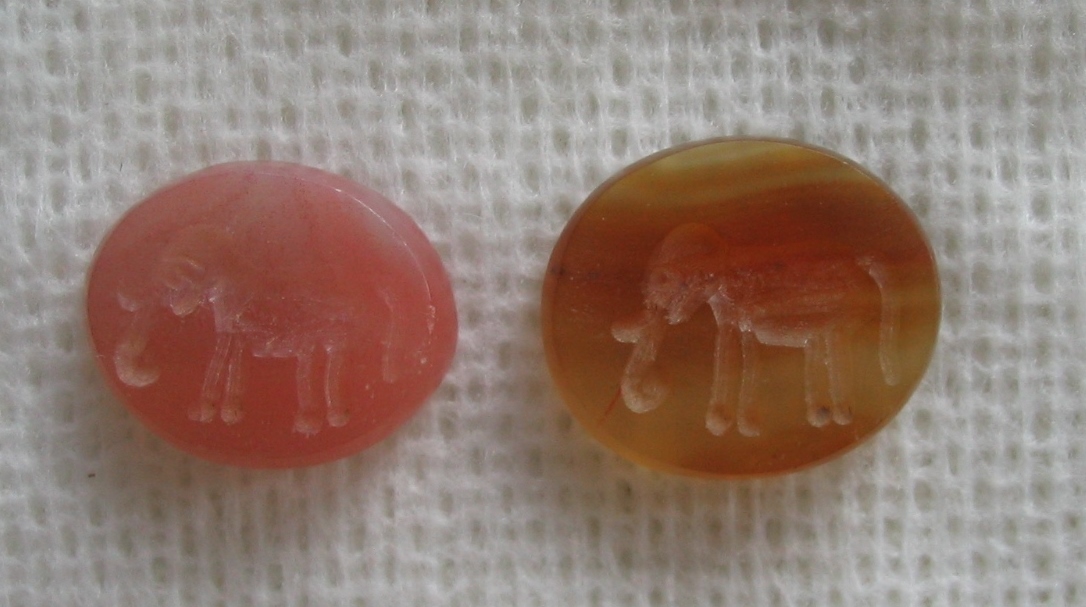
These 2 seals are from Cambodia and have intaglio carving of elephants.


elephant seals from Cambodia

 
While these seals may date to the Khmer period,( around 9th-13th centuries) present day Cambodian elephants take tourists for rides in Seam Reap as seen below.


Ride a friendly elephant
 
 And tourists riding on elephants are replicated in these modern  jade pendants from Myanmar.
 
 
Elephant rides depicted in modern  jade carving

 
The carved jade elephant below hails from China. It is perforated from top to bottom and so it is also a bead. Carved in the round with patches of brown, the body undecorated but showing ears,  tucked trunk, tail and eyes it measures 4x2cm       and is quite an engaging figure.


Jade elephant from China
 
 Most Chinese jade elephant carvings seen on the antiques market today are around the Qing dynasty. Ancient elephant carvings from China are not  common though elephants did roam the Central Plains judging from the many elephant tusks recovered from the  Jinsha and Sanxingdui  (around the 12-11th centuries BC) excavations in Sichuan Province, China. 


Showing ivory tusks from the Jinsha Onsite Museum


There is also a jade elephant excavated from Fu Hao's tomb, Shang dynasty(around 1766-1027BC)  But I doubt that my plumb little elephant is of that great age.  Except for the 2 horizontal carving lines on the belly there are  no decorative patterns that can relate it to an ancient  period. And yet it does not look like a modern copy -   so, another mystery....

 Here is a 1960s elephant made of bone or ivory from Thailand
 
 
vintage elephant from Thailand
 
And here is the whole vintage strand
 
 
Vintage strand of elephant, lotus and beads
 
Below is another strand composed of  greenstone beads, carnelian buttons and one small elephant.
 
 
Beads and pendants from Pyu dynasty
 
And finally, my favourite elephant and other greenstone bracelet. The centre bead is serpentine from China.
 
 
Composed of 2 elephants and other greenstone beads


Close up of the flat nephrite elephant bead which measures.10mm.
 
 
Greenstone  elephant bead from Pyu. 15mm long


Blog Archive

Favourite Books

  • Theft : a love story
  • The Uncommon Reader
  • The Silent Patient
  • Never Let me go
  • Angela's Angels
  • Where angels fear to tread