A Chinese dealer sold me this group of 13 jade bird pendants and said they were from the Shang dynasty (16th-11th century BC) My personal, if inexpert opinion is that they could date from Shang to Xi Zhou period (1046-771 BC) as these bird forms continue to be produced into 771 BC.
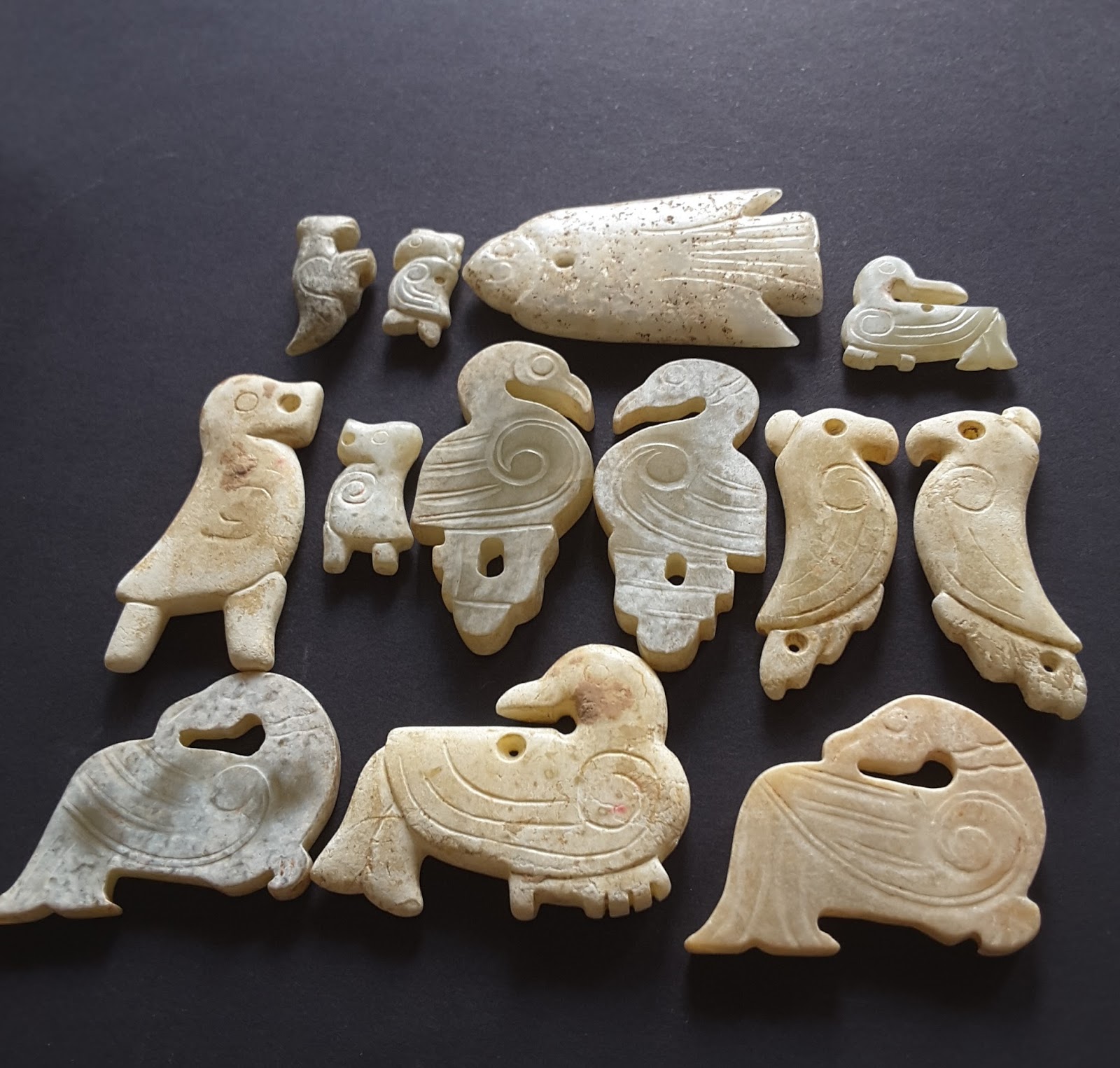 |
| 13 jade bird pendants |
Lest I be accused of misattribution I must hasten to add that none of the birds have been authenticated by any authority/expert. I don't know how clever forgers are these days or what are the red flags in these small pieces. However in support of their antiquity I would name several positive if general attributes such as presence of tool marks and traces of cinnabar, carving style is of the period, and patina and age of the stone appear genuine
The group of 13 birds consists of a pair of swans, 4 geese, 3 parrots, 2 flat mouth birds, one swallow and the last and smallest is one which I cannot really identify. The birds are well carved with prominent beaks and have bodies decorated with simple cloud scrolls and raised lines. The nephrite jade is mostly altered to white.
Five of the birds in the group belong to the waterfowl family and display elegant curved necks.
 |
| Swans and geese belong to waterfowl family |
Swans are symbols of beauty and they mate for life. It is no wonder they are usually shown in pairs like the ones below. The swans measure 4.1 x 2cm. |
| Swans mate for life and come in pairs |
2 of the geese are carved as flat pieces while the bottom piece , slightly bigger, is carved in the round with traces of cinnabar all over its body. They display the flexibility of their necks with a charming backward turning pose.
 |
| 3 geese showing off their graceful necks |
The gosling is cute, has an elongated beak and a stringing hole pierced through its body.
 |
| Little gosling, not an ugly duckling. |
This pair of birds, one taller than the other, with short, flat mouths (beaks) and short stubby legs, are also interesting. Both have holes bored through their beaks. I wonder what bird species is being depicted. Is it an owl ? Owl carvings were popular during Shang times.
 |
| 2 birds with short beaks |
The 3 parrots have arched backs, crests and curved beaks. The two bigger parrots have holes for eyes and also holes at the feet. The small parrot is pierced through the body.
 |
| A trio of parrots |
The swallow with folded wings look like its descending from a height.
 |
| Swallow descending |
It is pierced below the neck for stringing as a pendant. Despite extensive pockmarks and corrosion on its body it is still an attractive piece (in my eyes)Last and least (in size) is this little charmer which I am not even sure its a bird. Are those paws or wings that are clasped together ? It has a tail and the hole is bored through the clasped wings or paws.
It measures all of 1.8 x 0.9 cm.
 |
| Is this bird or animal ? |
To sum up here are all the birds again highlighted with a touch of glowing light.
 |
| Birds with a long history |


