Monday, August 24, 2015

Trapezoidal Jade Bead with Phoenix Pattern


Here is a very special bead that I purchased recently.

 
Trapezoid Jade Bead with incised phoenix

This trapezoidal bead, measuring 2cm long and 1.5cm wide   at the base, has an image of  a phoenix incised  on both sides.
 
Close up
 
The phoenix decoration on my bead bears resemblance to those seen on various jade ornaments from the Xizhou dynasty (1027-771BC)  According to the publication Chinese Civilization in a New Light * the phoenix was regarded as  harbingers of good fortune. There is a legend that during the reign of King Wen the sound of phoenixes pierced the hills of his kingdom and  this was interpreted as an auspicious sign for the Xizhou dynasty. Arising from this legend, phoenix patterns on jade ornaments became very popular during this period. (see extract below)

 
about the legend of the phoenix

The book Xizhou Yu qi Jades of the Xizhou dynasty shows several examples of similar phoenix patterns carved on plaques, bis, peis, and jues. Most of these ornaments are of jade with three of glass.  Over at the Shanxxi Taiyuan Museum there is a jade jue with incised phoenix on display attributed to  Xizhou. All these are large items as compared to the one I show.

I am thrilled with the double bonus of owning this mystical bird on a bead and using it as a centerpiece to compose my dream bracelet! Teamed with my red Xizhou carnelian disc beads and three contrasting turquoise disc beads of the same period .....feels great to have a bit of history/art on my wrist.:)


My dream bracelet
a little bit of history....a little bit of art....

*Chinese Civilization in a New Light. ISBN7-5326-0834-4


Tuesday, July 21, 2015

Fifty Shades of Purple


Purple  is my favourite color, but fifty shades ?  I don't think so. I have actually only a few shades, and mostly amethyst. Some shades mentioned in Wikipedia include the following:

amethyst, eggplant, fuchsia, indigo, lavender, magenta, mauve, orchid, plum, periwinkle, violet, mulberry, wisteria  
 
Being a purple person I have always wanted purple beads to go with my outfits but purple beads that are old and preferably ancient are scarce. So I was mighty pleased to come up with the three bracelets below strung in purply shades.
 

Purply shades
 

The top most bracelet features a large biconical faceted amethyst (maybe fluorite) bead as centerpiece, strung with small faceted biconical crystal beads. The crystal beads are ancient from Indonesia while the amethyst or fluorite is from China of unknown vintage and hopefully its also ancient or at least old.

Real cool beads!


 Bracelet no 2 shown below has another large amethyst (not sure whether its fluorite)bead as centre piece(I bought 3 of these beads at one go, so I still have one more to think up a design) this time strung with dark purple semi round pearls.


Dark and light shades of purple


The purple pearls are also from China and I have a feeling they are new and dyed  but they add another shade of purple  and contrast fabulously with the light amethyst bead.

The last  bracelet  uses 3 small amethyst or fluorite beads as accents to enhance the crystal, agate and moonstone beads. The old crystals are from Vietnam and all the rest  from Kashmir.


Amethyst accents light up the ancient crystals


In my purple mood I dug into my bead chest and managed to turn up a few ancient beads in varying shades of purple


Ancient lotus beads from Myanmar, likely Pyu dynasty

 
Amethyst lotus bud from Cambodia more likely vintage than ancient


And my most prized, purply  eyebead  from Warring States period (475-221BC). There are altogether 15 purple dots on this dotty bead!


Dotty eyebead from Warring States

Yet another  eyebead in dark and light shades of lavender.


Ancient glass eyebead
 

The last piece of purply stuff that I show has been handmade by me to celebrate this purple shades post. Its a  kumihimo braided bracelet. It uses an antique jade button (alas not purple jade but green jade) as the clasp and sits well on the wrist.
 

Kumihimo Braided Bracelet


Wednesday, June 3, 2015

BESPOKE BRACELET

 
Here's a modest handmade bracelet I knotted for casual wear. Though it calls for no great skills, more like child's play, making them is really a labor of love as each knot has to be individually tied. Maybe that is why knotted bracelets are called Friendship Bracelets as each knot is tied with love.
 

Friendship Bracelet


This bracelet is made using the simple chevron knot and six strands of  embroidery floss. 
 
 
chevron pattern

 
For the closing I have used an antique jade button as a clasp.
 
 
Jade button as clasp

 
 The little jade button can double as an ornament on the wrist side.
 
 
Jade button doubles as decoration

 
The versatile little jade button is also hand carved. 
 
 
Carved by jade master, ages ago.

 
This uniquely crafted bracelet combining handmade knots with an antique jade button really makes it one of a kind. I daresay  after searching through the net that there are not many around which makes it both original and bespoke !
 
So Bespoke !


Thursday, April 23, 2015

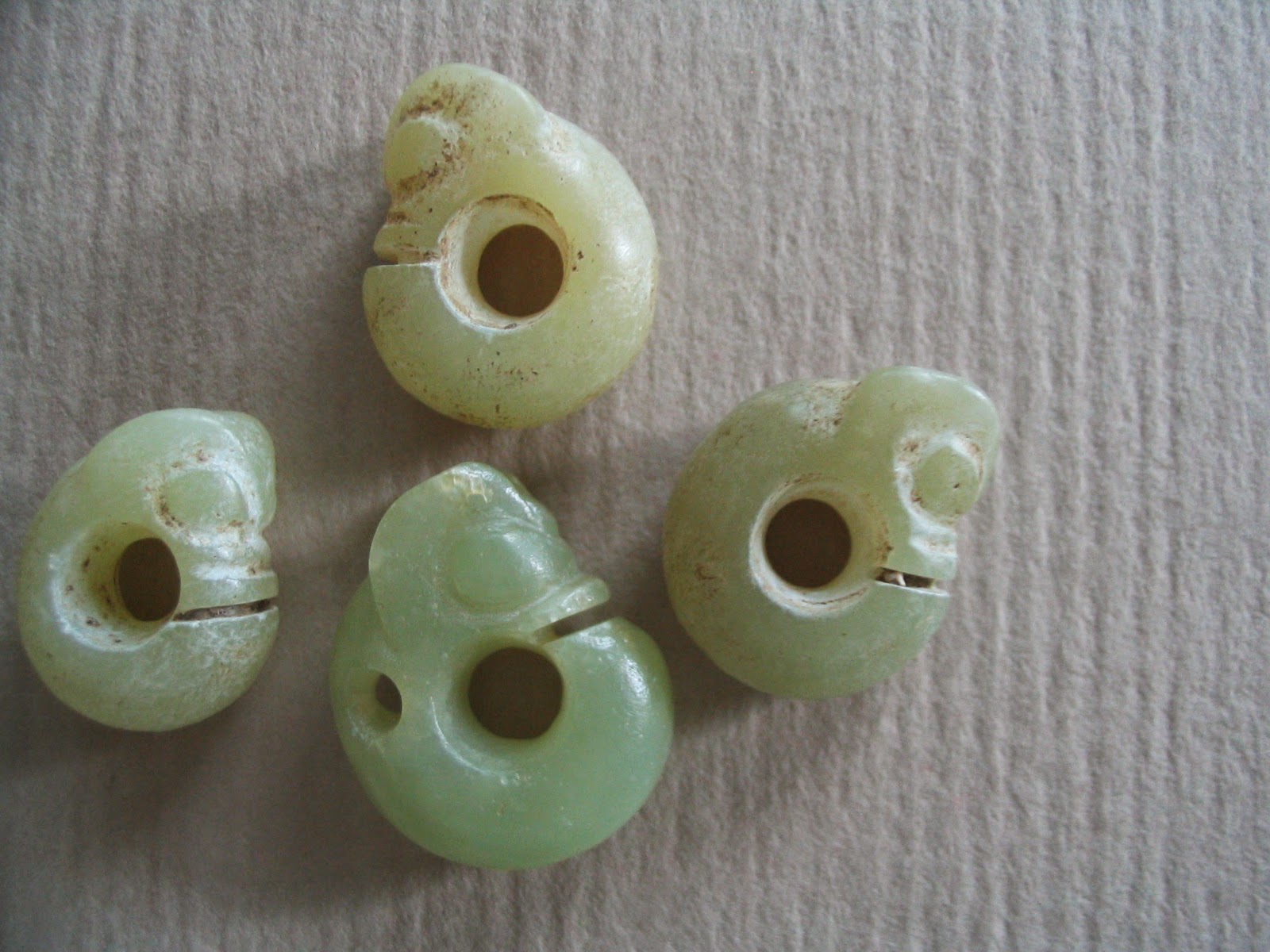
BABY ZHULONGS


Is this a Pig or a Dragon ? That is the question whether its a celestial dragon or a plebian pig....puzzles the  mind and makes us fly to wild theories ...:))

 
Pig or Dragon?

The experts says both hence Zhulong  as  Zhu=Pig and Long=Dragon. An unlikely marriage if you ask me. How a celestial mythical dragon became married to a plebian pig  baffles the brain but according to Wikipedia :
 
A pig dragon or zhūlóng (Chineset 豬龍, s 猪龙) is a type of jade artifact from Neolithic China. Pig dragons are zoomorphic forms with a pig-like head and elongated limbless body coiled around to the head and described as "suggestively fetal". Early pig dragons are thick and stubby, and later examples have more graceful, snakelike bodies.


8 Zhulongs


Zhulongs are  hallmarks of the Neolithic Hongshan Culture (c. 4000–3000 bce) and are normally large imposing figures so I can't account for why my lot of 8 zhulongs  is so mini. Are they genuine artifacts or replicas is another unanswerable question. The only  examples of small size zhulongs that I have seen are documented in the book Language of Adornment by Filippo Salviati who showed 2 examples of mini zhulongs measuring 1.6cm x 2.2cm and another 3cm x 4 cm which are still larger than my pieces. 
 
 In the picture below my largest zhulong measures only 1.9 x1.6 cm   and  1.5 x1.3 cm for the smallest. All have uncut central perforations and of the 8 only 1 has a stringing hole. They also show the Hongshan characteristics of large heavy lidded  pop out eyes, curled up body, fly back ears and nose creases.


8 baby zhulongs
 
Four of the zhulongs are made from calcite
 
 
Calcite zhulongs

One of the calcite zhulongs is badly corroded on one side.
 
 
badly corroded on one side

 
Here are the rest of the zhulongs in nephrite jade.
 
 
Jade zhulongs


2 of the zhulongs are chewing on some ancient quartz. I know this quartz in a hole on ancient jade has been debunked by experts as  ploys to fake authenticity. But on these two it looks pretty natural
 
 
Zhulong chewing on quartz

 
 Although diminutive in size they still exhibit the essence of zhulongism especially that inimitable  expression of "the grimacing sneering look" as described by some writers. At the same time their smallness and coiled body makes them look less like some fearsome beast but more like a cuddly amulet ! (depends how you look at them) or even a panda.
 
 
Grimacing but cuddly !


According to some sources, zhulongs are recorded as being made "as late as the Shang dynasty..." around 1600-1050 BCE and I cherish hopes that mine may be Shang creations  which is still an immortal 3,000 (more or less) years ago.

 
immortal in terms of age!


Friday, March 27, 2015

New Life for Old Charms


This bagful of dusty, old jade charms had been sitting in my drawers for some years now.

Bagful of old jade charms
Occasionally I would dig them up to make the odd earring for a Christmas or New Year gift. Because these charms had a random pre-life (as hairpin, toggle or accessory) it is hard to find an exact matching pair for earrings.


Charms of every shape and size - hard to find an identical pair


And earring wearers are also loth to put on unmatched pairs, so it had not been an altogether  successful  project for these hand cut charms

Mismatched charms


While mulling over them one day I had an epiphany and I was struck by a sudden brainwave to reinvent them into jade sprays. Learning to wire these charms into a spray needed a few hours to master.

Practice piece

From this charm making exercise I also got an opportunity to use and show off antique glass bottles from my old bottles collection. These bottles had been languishing in shoe boxes with nary a glance from admirers showered on them and now they have been rejuvenated!  Look,  how well they complement my little jade sprays.


Antique glass bottles complement my jade sprays
These bottles are also interesting old glass specimens. The two end bottles look like 1920's perfume bottles and the gourd shape bottle could have been used for Chinese herbal medicine. Next to it is a carved crystal snuff bottle which I have converted into mini vase for my jade spray.
I have also roped in a 1970s or 80s Joy perfume bottle to plant my jade spray with pearl accents, shown below.
Joy and Jade make a lovely pair!

My jade sprays stand out  below with  my 1,000 year old Sung dynasty (960-1279AD) greenware pot. Together they form a classic composition.


Unending beauty - jade and Sung greenware

Wiring these tiny charms into sprays have been therapeutic . How they cheer me and heal the stress and pain of daily living.

Jade as healer


Wednesday, February 18, 2015

Lunar New Year of the Goat


I don't know why goats/rams/sheep/lamb are considered lucky by the Chinese  but this  belief  has been passed down through generations. There's a Chinese saying san yang kai tai or 3 goats start a fortune.  To ring in the Year of the Goat 2015 then,  I will show  some of  my goat collectibles especially in groups of three like the picture below.


san yang kai tai or 3 goats a fortune make.


Below are another 3 jade goat mascots of good luck for 2015. These 3 are pendants - the one on the left has the money or coin symbol on the reverse and must have been made to commemorate the goat year in a previous cycle.

Goat pendants
Reverse has double coins to double the luck for year of goat.


Next is an interesting goat bead. It is pierced through  the body and intended to be a dangle. This  serious looking goat also has a beard....so that's where the term goatee comes from :)
goatee comes from goat's beard !

Heng has contributed a  couple more goats/rams carved from serpentine from his collection.  Looks like a mother and child pair.
Ram or goat ?


2015 is the year of the Wooden Goat but as I have no wooden goats to show  I'll make do with a pair of vintage metal lambs which came from Hilltribes of Thailand.

bleat! bleat1

Rummaging among my collectibles looking for goats to display, I retrieved this long forgotten porcelain goat/sheep purportedly from Song dynasty (960-1279AD). Of yin qing glaze, it is large but roughly potted. Guess it could make nice mutton soup for Song folks :)
Can make a nice mutton soup!


Another quirky pair is this wool on rice paper picture of a nanny goat and a billy goat nibbling grass beneath cherry or prunus blossoms.   Using wool to make a picture of a goat is quite appropriate and I must say the goats wear their wool well. I am not sure whether its pure lamb's wool or even maybe silk threads imitating wool. I bought the picture at a garage sale more than thirty years ago. It was already framed and old at the time of purchase,  so I reckon the vintage to be at least 80 years. 


Nanny goat and billy goat.


Lastly here is  the handmade lamb's work that I stitched more than 20 years ago (see date 1988 on cross stich)


Little lamb who made thee?

To end on a cheerful note and add the obligatory CNY red , (so far missing from this post) is this greeting for the new year.
  
Wishing All Collectors Goat Luck for 2015
Tian Tian Xi Xi Yang Yang !


Tian tian xi xi yang yang


Monday, January 26, 2015

Of Necks, necklaces and bracelets


Like Nora Ephron I too  'feel bad about my neck'  and that is why, avid bead collector that I am, I seldom wear my beloved beads as necklaces, which are mostly enjoyed as a collector's strand. Instead I choose to wear my beads as bracelets. This also has the advantage of the beads being visible to me as well as drawing the eyes of  any keen onlookers though, sadly this has not often been the case. Guess people here only go for gem stones and don't appreciate "faded beauties" like my age-old beads.

 
More than 2 dozen bracelets

 
Below I will highlight some favorites  in my bead  bracelets wardrobe. First I will show the reds mostly of carnelians strung with some agates and coral spacers. These beads date from 500 to thousands of years old. The etched ones are mostly from Myanmar. 


Carnelians from Myanmar, Indonesia and Vietnam
 
Carnelians mixed with crystals and glass is also favoured by me
 
 
Dazzling Reds
 
Top most bracelet features a large hexagonal carnelian bead, faceted crystals and dusky red glass beads all from Vietnam. Bottom left bracelet is Chinese in origin. The carnelian and turquoise disc beads are probably Xizhou (1046-256BC)  while the dogbone shape crystal is also from some early Chinese dynasty. All the faceted carnelians on right bracelet are antique beads from Indonesian.
 
 
Green and shades of green, blue green are also what I collect and wear.
 
 
Greenstone and carnelian

Bracelet on the left composed of greenstone and carnelian beads from Myanmar. On the right, central bead from China, mixed with greenstone beads from Myanmar including 2 elephants.

The mix of stone and glass beads shown below are from Myanmar and neighboring Vietnam.
 
 
Stone and glass beads
 
Yellow is not one of my favorite colors but I have a couple of bracelets in Van Gogh yellows to cheer a dull day.
 
 
Very Van Gogh (I wish!)
 
On the left the central yellow bead with red and green flowers is  Venetian and reminds me of Van Gogh's colors. The two beads with red dots, next to  the central bead,  come from Lhasa, the top of the world  while the small plain yellow disc beads are from Indonesia. Quite an international combination for this bracelet. On the right are African trade beads with fancy names many of which I cant recall except for the two French cross beads.
 
 
French cross beads

The next one is a recent acquisition. I think its made of quartz and carnelian, carved in ribbed segments. Not sure about the age and vintage but comes from Zhejiang, China.
 
 
Barrel shape beads carved in ribbed segments

 
Agates are one of my favourite stones and here are two from Myanmar
 
 
Agates are my favourite stones

 
Kashmir may be famous for its houseboats and picturesque scenery  but it also home to a  large variety of semi precious stones. My next bracelet is composed from amethyst, moonstone, quartz and agates from my long ago trip to Kashmir.
 
 
Semi-precious stones from Kashmir


Beads in my bead bracelet wardrobe, come from all over the globe !
(o that rhymes :))

Blog Archive

Favourite Books

  • Theft : a love story
  • The Uncommon Reader
  • The Silent Patient
  • Never Let me go
  • Angela's Angels
  • Where angels fear to tread